
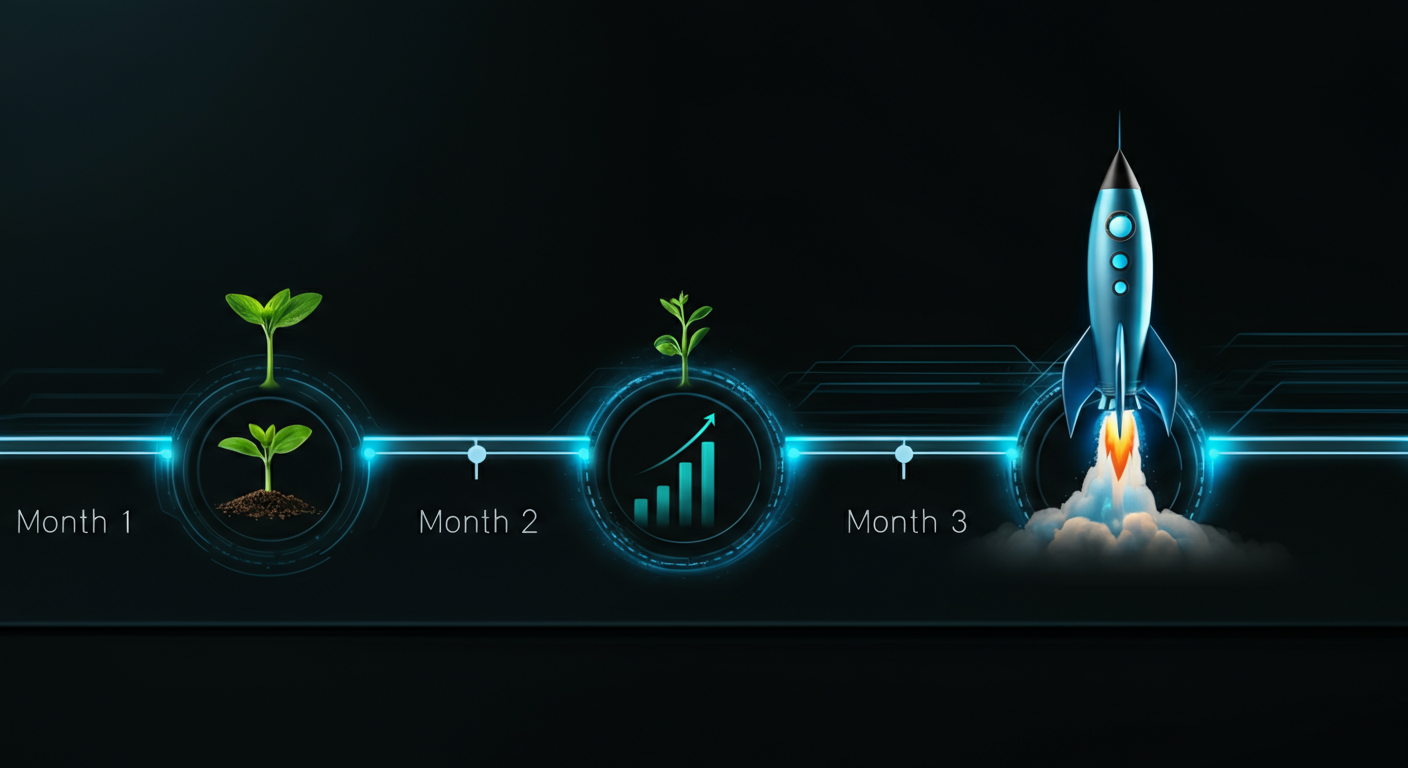
The 90-day paid ads ramp is the minimum realistic timeline to evaluate whether a paid media program is working. Businesses that quit in week 3 because the first campaigns are “not converting” are making the same mistake as a gym member who quits after two workouts because they do not have abs yet. Understanding what each phase should deliver, and what you should be doing during each, prevents both premature abandonment and misplaced confidence.
Why Paid Ads Take 90 Days to Optimize
Paid ad platforms are machine learning systems. Google’s Smart Bidding and Meta’s Advantage+ both require data to improve. The learning phase — when the algorithm is figuring out who converts and at what times and from which placements — typically requires 50–100 conversions before it exits. At a conversion rate of 5% and 100 clicks per week, that is 20 weeks of data. Aggressive early budgets compress this timeline dramatically.
The 90-day framework assumes a minimum viable budget (typically $3,000–$10,000/month) and consistent creative testing. Lower budgets extend all timelines below proportionally.
Month 1: Foundation and Learning
What to do in month 1:
- Build and launch campaigns with baseline structure (not the final structure — this will evolve)
- Install and verify all conversion tracking before spending a dollar on media
- Set up Google Analytics 4 with properly configured goals
- Launch 3–5 creative variants per ad set to gather initial performance data
- Do not make significant changes for the first 7–10 days — you need data before making decisions
What to expect in month 1:
- Higher CPLs than your eventual targets (30–50% above benchmark is normal)
- Uneven performance across ad sets — some will look great, some terrible, before the algorithm settles
- Few conversions (possibly zero in the first 1–2 weeks for smaller budgets)
- Valuable audience and creative data that informs month 2
Month 2: Optimization and Signal Gathering
What to do in month 2:
- Kill the bottom 30% of ad creatives by cost-per-result and reallocate budget to winners
- Launch new creative variants based on month 1 learnings (different hooks, formats, offers)
- Tighten targeting: exclude irrelevant audiences, add negative keywords
- Build retargeting audiences from month 1 website traffic and video viewers
- Review search term reports (Google) or placement reports (Meta) for irrelevant spend
What to expect in month 2:
- CPLs beginning to decrease as learning data accumulates
- First statistically significant data on which messaging angles resonate
- Retargeting campaigns beginning to generate lower-cost conversions
- Clearer picture of which audience segments are converting best
Month 3: Scaling What Works
What to do in month 3:
- Scale budgets on proven campaigns (increase spend 20–30% at a time, not 2x overnight)
- Expand to new audiences based on lookalikes from month 1-2 converters
- Test new landing page variants against the month 1–2 baseline
- Implement lead quality feedback loop (sales team reports which leads booked and closed)
- Begin planning month 4–6 creative refresh to avoid fatigue
What to expect in month 3:
- CPLs approaching or at target benchmarks
- Positive ROAS on retargeting (typically the first campaigns to turn profitable)
- Prospecting campaigns at or approaching profitable returns for high-ticket services
- Clear top-performing creative formats and messaging angles identified
The Biggest Mistakes That Derail the 90-Day Ramp
- Changing campaigns too often: Each change resets the learning phase. Resist the urge to modify campaigns more than once per week during months 1–2.
- Under-budgeting: Budgets too low to generate conversions never exit the learning phase. The minimum viable budget for most competitive categories is $3,000/month.
- Not tracking conversions correctly: Running campaigns with broken tracking is the most expensive mistake in paid media. Verify every conversion event before spending.
- Expecting immediate ROAS: The goal of month 1 is data, not profit. Evaluate month 1 by learning quality, not return.
- Stopping when CPLs are high: Stopping at month 1 because CPLs are above target is the equivalent of removing bread from the oven before it bakes. The algorithm needs time.
Frequently Asked Questions
How much should I spend per month for paid ads to work?
Minimum $2,000–$3,000/month to generate enough data to optimize. Most competitive service categories need $5,000–$15,000/month to reach target CPL within 90 days. Below $2,000, extend your evaluation timeline to 6+ months.
When should I see my first leads from Google Ads?
Typically within the first 1–2 weeks if targeting high-intent keywords with adequate budget. Meta Ads may take 2–4 weeks before delivering consistent leads from cold audiences.
What is the learning phase in Google Ads?
The period (typically 1–4 weeks) during which Google’s Smart Bidding algorithm is actively learning which users convert. During this phase, CPLs are often higher and performance is less predictable. Do not make major changes during the learning phase.
Should I use a landing page or my website homepage?
Always use a dedicated landing page matched to each campaign. Homepages have navigation and multiple competing CTAs. Dedicated landing pages convert 2–5x better than homepage traffic.
How do I know if my ads are actually working?
Define your target metrics before launch: target CPL, target conversion rate, target ROAS. Evaluate performance against these benchmarks at 30-day intervals, not week-by-week noise.
UNHOOKED manages the full 90-day ramp as part of every performance marketing engagement. Book a fit call to see the launch plan.