
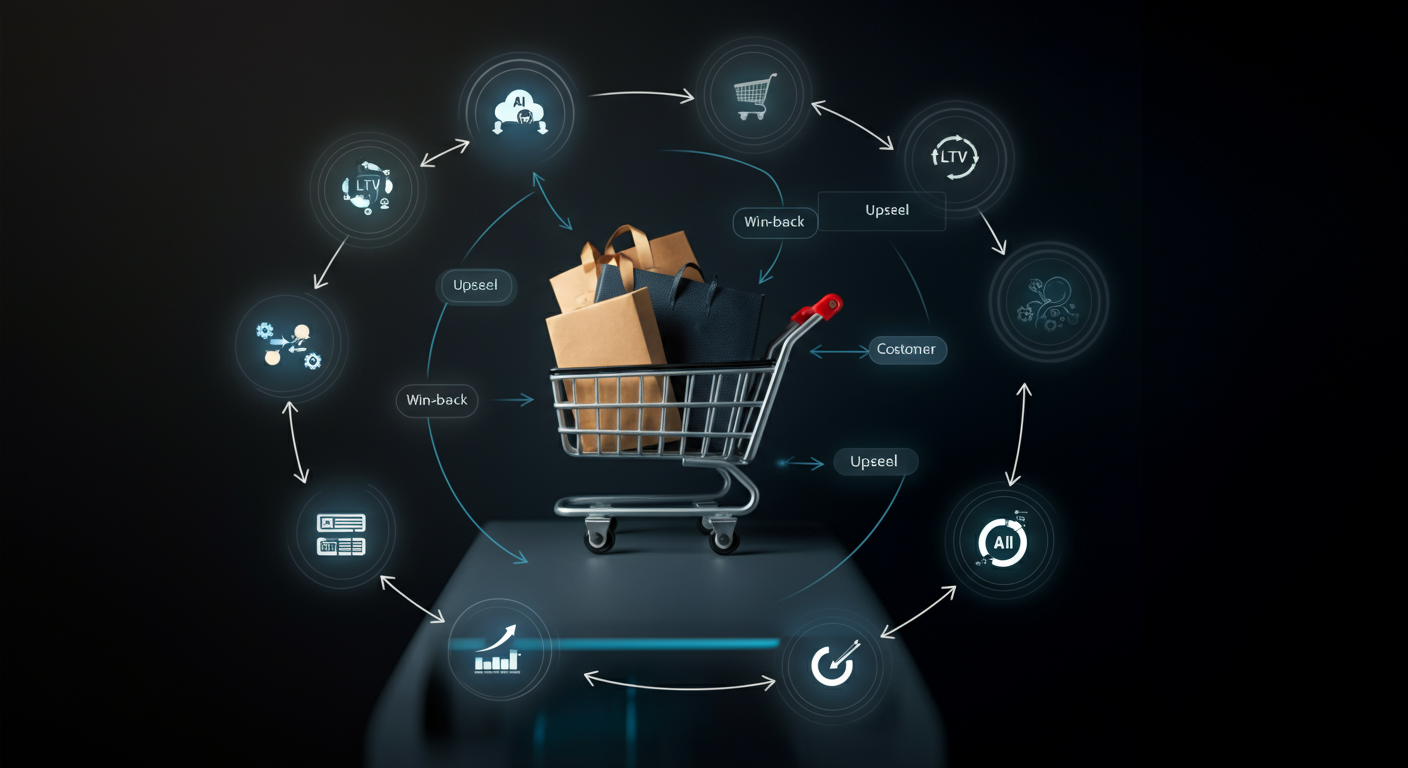
AI marketing for e-commerce has evolved far beyond the abandoned cart retargeting ad — the businesses growing fastest in 2025 are using AI to automate customer lifecycle interventions that increase LTV, reduce churn, and reactivate dormant customers at scale. Retargeting remains important, but it operates on the 2–3% of visitors who converted to website visitors. AI lifecycle marketing operates on 100% of your customer base — maximizing revenue from people who already trust you enough to have bought once.
The 5 AI Marketing Interventions Beyond Retargeting
1. AI-Powered Cart and Browse Abandonment Recovery
Standard cart abandonment emails have industry average recovery rates of 4–6%. AI-powered sequences that adapt timing, messaging, and offer based on product category, cart value, and customer purchase history achieve 12–18% recovery rates. The implementation: when cart abandonment is detected, an n8n workflow triggers a 3-email sequence with timing and content optimized for the product type and customer segment.
2. Post-Purchase Upsell Sequences
The highest-converting upsell window is 48–72 hours after a purchase — the customer is still in a positive emotional state from the purchase decision. AI marketing automates: a day-2 email with complementary product recommendations (not random — based on what customers who bought the same item also purchased), a day-7 email based on product usage stage, and a day-30 reorder reminder for consumables.
3. Win-Back Campaigns for Lapsed Customers
Customers who have not purchased in 90–180 days (depending on your average purchase cycle) are candidates for AI-powered win-back campaigns. An AI analyzes purchase history to predict which lapsed customers are most likely to return and sends personalized reactivation offers based on their purchase category preferences, order values, and the products they previously browsed.
4. Subscription and Subscription Box Churn Prevention
For subscription e-commerce, AI can identify at-risk subscribers before they cancel by monitoring engagement signals (email open rate declining, order skips increasing, support tickets) and triggering proactive interventions. An AI voice agent calling a subscriber who has skipped 2 consecutive orders (“We noticed you paused — was everything okay with your last order?”) reduces churn when implemented correctly.
5. High-Value Customer Identification and VIP Programs
AI models can identify customers most likely to reach VIP status based on early purchase patterns. Instead of waiting for customers to organically cross purchase thresholds, proactive VIP enrollment outreach (AI-triggered email at the 70% threshold of VIP status) accelerates the behavior that generates highest LTV.
Frequently Asked Questions
Does AI marketing replace Meta retargeting for e-commerce?
No — retargeting is still essential for converting website visitors who have not yet purchased. AI lifecycle marketing operates on buyers (people who have already purchased). Both operate simultaneously: retargeting converts prospects, AI lifecycle marketing maximizes buyer LTV. The combined system significantly outperforms either alone.
What AI tools are used for e-commerce lifecycle marketing?
Klaviyo (email/SMS automation with AI predictive tools), n8n or Make (for complex workflow automation across platforms), Vapi (for high-value customer outreach via AI voice), and Shopify or BigCommerce native analytics for customer lifetime value segmentation. Most mid-market e-commerce brands are on Klaviyo — it is the category standard.
How do I measure the ROI of AI lifecycle marketing?
Compare revenue per customer cohort (30-day, 90-day, 365-day LTV) before and after AI implementation. Also track specific intervention metrics: cart recovery rate, repeat purchase rate within 60 days, win-back campaign conversion rate, and subscription churn rate. A 15–25% improvement in 90-day LTV is a realistic outcome for well-implemented AI lifecycle marketing.
Can small e-commerce stores afford AI marketing?
Tools like Klaviyo have pricing tiers accessible to small stores (free up to 500 contacts). n8n is open-source and can be self-hosted for minimal cost. The primary investment is setup time or agency fees for configuration. A store generating $50,000+/month in revenue typically has enough lifetime value per customer to justify AI lifecycle marketing investment.
What is the biggest e-commerce AI marketing mistake?
Treating all customers identically in automated sequences. Customers who bought luxury items, customers who bought consumables, and customers who bought one-time gifts have completely different upsell profiles and optimal contact frequencies. Segment first, automate second.
UNHOOKED builds AI marketing systems for e-commerce brands. Book a fit call to map your current LTV gaps.