
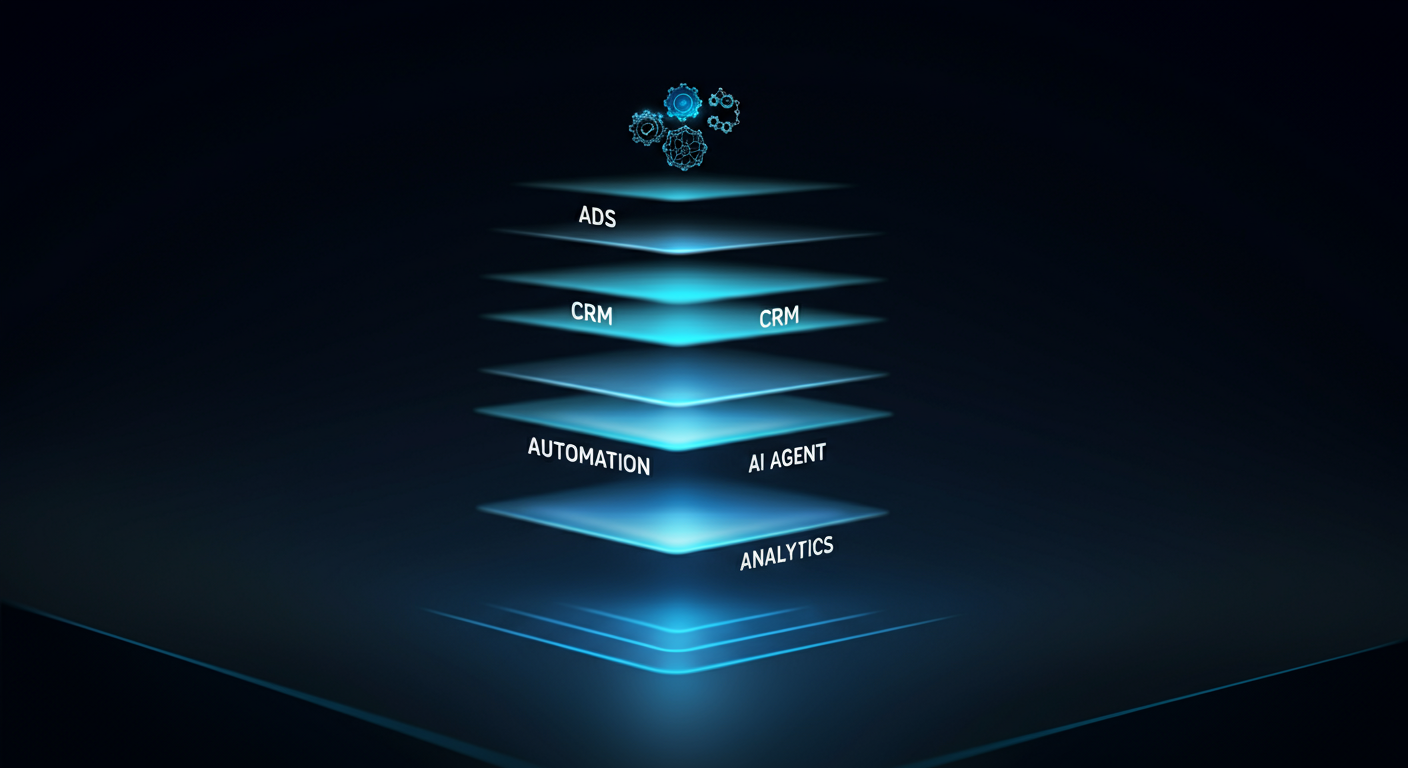
The AI marketing tech stack that generates consistent leads for service businesses in 2025 is surprisingly lean: five categories of tools, each serving a specific function, integrated in a specific order. The businesses wasting the most money on marketing technology are using too many tools with too little integration between them. The businesses generating the best results are using fewer tools, integrated deeply, with clear data flowing between every layer.
The 5 Layers of the AI Marketing Stack
Layer 1: Traffic Generation (Ads Platforms)
Every marketing system needs a consistent, controllable source of attention. Organic SEO is the long-term foundation, but paid advertising is the lever that produces predictable, scalable volume:
- Google Ads: Search, Performance Max, YouTube — captures high-intent demand
- Meta Ads: Facebook, Instagram — creates demand from cold audiences
- LinkedIn Ads (optional for B2B): Higher CPL but extremely precise B2B targeting
Budget: $3,000–$15,000/month depending on category and scale goals. The platform is not the differentiator — the creative, targeting, and landing page are.
Layer 2: CRM (The Data Hub)
Your CRM is where every lead lands, every conversation is logged, and every deal is tracked. Without a CRM, every lead is a silo and no marketing decision can be made from data:
- HubSpot: Best for service businesses needing strong email automation + deal tracking. Free tier for basics, Starter at $15/month/user.
- GoHighLevel: All-in-one platform (CRM + landing pages + SMS + calendar) purpose-built for agencies and local service businesses. $97–$297/month.
- Salesforce: Enterprise-grade, required at $10M+ ARR. Overkill below that threshold.
Critical: CRM must have API access and webhook support. This is non-negotiable for AI integration.
Layer 3: Automation Engine (Workflow Orchestration)
The automation engine connects your CRM, ads platforms, AI agents, and communication tools. This is where most businesses have the biggest gap — they have data in multiple places but nothing moves it automatically:
- n8n: Most powerful, open-source, ideal for complex multi-step workflows. $20/month cloud or self-hosted.
- Zapier: Easiest to use, less flexible, higher cost at scale. $19–$49/month.
- Make (formerly Integromat): Middle ground — more powerful than Zapier, easier than n8n. $9–$16/month.
Your automation engine should handle: new lead routing, AI agent trigger and status updates, CRM updates from agent calls, follow-up email sequences, and reporting data aggregation.
Layer 4: AI Agent Layer (Instant Response)
The AI agent is what turns a lead list into booked meetings — automatically, at any hour, in any volume:
- Vapi: Most developer-flexible voice agent platform. Build custom agents with any LLM, TTS, or transcriber. $0.05–$0.15/minute of call time.
- Bland AI: Purpose-built for high-volume outbound calling. Simpler configuration, faster deployment.
- Retell AI: Most user-friendly interface. Best for teams without developer resources.
- OpenAI + custom infrastructure: Maximum control but requires significant development investment.
The AI agent integrates with your CRM (via your automation engine) to look up lead data, update call outcomes, and trigger follow-up sequences without human intervention.
Layer 5: Analytics and Reporting
Without visibility into what is working, every optimization decision is a guess:
- Google Analytics 4: Free, required for conversion tracking and traffic analysis
- Google Looker Studio: Free dashboard builder that connects GA4, Google Ads, and Sheets into one view
- HubSpot Reports: CRM-native reporting on lead source, deal stage, and closed revenue by channel
- Triple Whale or Northbeam (optional): Multi-touch attribution for businesses spending $50K+/month on ads
Integration Order: Build It in This Sequence
The order of implementation matters. Building out of sequence creates rework:
- Step 1: CRM setup (HubSpot or GoHighLevel) — all roads lead here
- Step 2: GA4 + conversion tracking — never spend on ads without measurement in place
- Step 3: Landing pages — build them before launching ads
- Step 4: Ads platforms — now you can drive traffic with tracking in place
- Step 5: Automation engine — connect your CRM to everything
- Step 6: AI agent — integrate with CRM and automation, test end-to-end
Frequently Asked Questions
How much does a full AI marketing tech stack cost per month?
A complete stack for a growing service business runs $500–$2,000/month in tool costs, not including ad spend. CRM ($0–$300), automation ($20–$100), AI agents ($100–$500), analytics (mostly free). The ROI multiple makes this cost trivial relative to the revenue generated.
Do I need all five layers to start?
Start with CRM + GA4 + one ads platform. Add automation and AI agents when you have consistent lead flow to respond to. Do not build automation infrastructure before you have leads to automate.
Can I use GoHighLevel instead of multiple tools?
GoHighLevel replaces CRM + landing pages + basic automation + SMS + calendar in one platform. It is the right choice for local service businesses and agencies. For complex B2B requirements (Salesforce integration, advanced HubSpot workflows), separate tools are more appropriate.
What is the most important tool in the stack?
The CRM. Every other tool feeds into it or out of it. A broken or unused CRM means every lead and every conversation is disconnected from the data needed to make marketing decisions.
Can I integrate AI voice agents with GoHighLevel?
Yes — GoHighLevel has native integrations with several AI voice agent platforms, and n8n or Zapier can bridge any gaps for custom webhook-based integrations like Vapi.
UNHOOKED builds and manages the full AI marketing stack as part of every client engagement. Book a fit call to map your current stack gaps.