
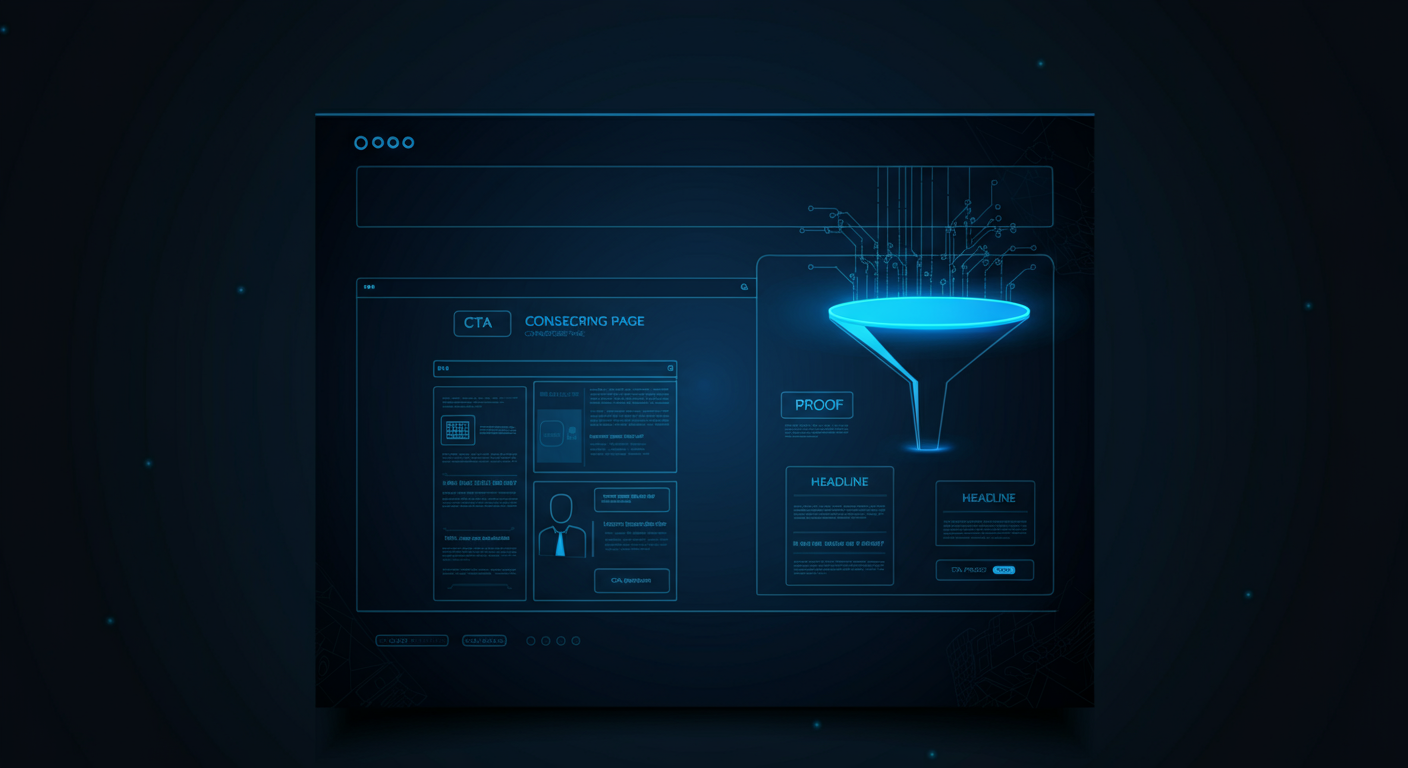
A high-converting landing page in 2025 follows a strict hierarchy: the first 5 seconds determine whether the visitor stays, and everything below the fold determines whether they convert. Most landing pages fail at the first 5 seconds because they open with what the company does instead of what the visitor gets. This guide covers the structure, copy, and design elements that move visitors to action.
These principles apply to any service landing page — whether you are running Google Ads, Meta Ads, or driving SEO traffic.
The 5-Second Test: Above the Fold
Your above-the-fold section (everything visible before scrolling) must accomplish four things:
- Communicate who this is for
- State the specific outcome or benefit
- Establish credibility (one trust signal)
- Present a clear next action
The most common mistake: a generic headline like “Marketing Solutions for Your Business” that could apply to 10,000 companies. Replace it with something specific: “Get 10 Qualified Sales Calls Per Week — Without Cold Outreach” or “Launch AI-Powered Ads in 3 Weeks. More Calls. Less Busywork.”
The headline formula that converts: [Specific Outcome] + [Timeframe] + [For Whom] (optional). Not what you do, not who you are — what they get, and when.
The Full Page Structure That Converts
Below the fold, the page should flow through this sequence:
- 1. Problem statement: Articulate the pain clearly enough that the reader feels understood. “You’re spending on ads but getting unqualified leads. Your sales team is chasing ghosts.”
- 2. Stakes (cost of inaction): What does staying stuck cost per month? Per year? Make it real.
- 3. Dream state: Paint the picture of life after the solution. Concrete and specific.
- 4. Mechanism: How does your service achieve the result? One clear sentence, not a feature list.
- 5. Social proof: Case studies, testimonials, logos, numbers. At least one before the primary CTA.
- 6. The offer: Exactly what they get, what it costs, what happens next.
- 7. CTA: One action. Specific benefit stated. Low-friction entry point.
Headlines That Convert (With Formulas)
The headline is the highest-leverage element on the page. A/B test headlines before testing anything else:
- Outcome formula: “Get [Specific Result] in [Timeframe]”
- Problem formula: “Stop [Frustrating Thing]. Start [Desired Result].”
- Social proof formula: “How [Number] [Target Audience] [Result] Without [Objection]”
- Bold claim formula: “[Specific Metric] Guaranteed — or You Pay Nothing”
CTA Design: One Action, Maximum Clarity
The most effective CTAs in 2025 share four characteristics:
- Benefit-stated: “Get My Free Strategy Call” not “Submit”
- Low commitment language: “Book a 15-Min Call” outperforms “Schedule a Consultation”
- Single focus: One CTA per page (or one primary with anchored secondary)
- Color contrast: The button must visually pop against the background
Social Proof: The Trust Elements That Move Buyers
Trust signals ranked by conversion impact for service businesses:
- Highest impact: Specific case study with numbers (“From 3 booked calls/week to 22 in 90 days”)
- High impact: Video testimonial from a recognizable company or person in your target market
- Medium impact: Written testimonials with full name, company, and photo
- Medium impact: Client logos (if they are recognizable to your audience)
- Lower impact: Star ratings without context, anonymous testimonials
Page Speed and Mobile: Non-Negotiable in 2025
Google’s Core Web Vitals are a ranking factor, and slow pages cost conversions. Target: Largest Contentful Paint under 2.5 seconds, First Input Delay under 100ms, Cumulative Layout Shift under 0.1. On mobile, ensure the CTA is visible and tappable without scrolling. Over 60% of paid traffic now converts on mobile for most service categories.
Frequently Asked Questions
How long should a landing page be?
Long enough to answer every objection and short enough to not bury the reader. For high-ticket services ($5,000+), longer pages (1,000–2,000 words) tend to convert better because they need to build more trust. For low-friction offers (free trial, discovery call), shorter pages work. Test both.
Should I use video on my landing page?
A 60–90 second video that explains the offer, shows social proof, and presents a clear CTA typically increases conversions 20–80% when the page traffic is warm. For cold traffic, static pages with strong headlines often outperform video above the fold.
What is an average landing page conversion rate?
Industry average across all categories is 2–5%. High-performing pages for service businesses convert 8–15% of cold traffic and 20–40% of warm retargeting traffic. If you are below 3%, fix the headline and CTA first.
How many form fields should I include?
Every additional form field reduces conversion rate by roughly 10–15%. For top-of-funnel offers, use name + email only. For high-intent discovery calls, name + email + phone + one qualifying question is acceptable.
Should the landing page match my main website design?
It should feel like the same brand, but dedicated landing pages without navigation menus consistently outperform pages that let visitors click away. Remove the main site nav on all landing pages.
UNHOOKED builds landing pages as part of every client launch — designed to convert paid traffic from day one. See what a full AI marketing build looks like.